Leave Your Message

Why Use Aluminium T Slot Profile for Modular Frames?

Modular frames need to adapt when layouts, equipment, or production needs change. An Aluminium T Slot Profile offers a practical way to build structures from joined sections, brackets, and standard fasteners. Its T-shaped slots let users position components along the frame, rather than relying on fixed holes. That flexibility can help when assembling machine guards, workbenches, display stands, or test rigs. Small changes matter.

The profile’s value depends on more than its shape. Alloy, section size, wall thickness, connector choice, and load direction all affect frame performance. A light-duty stand may need a different design from a frame supporting moving equipment. Careful measurement and sound engineering judgment are essential; modular parts do not automatically make a structure safe or rigid. Check the supplier’s load data, consider vibration and deflection, and test the finished assembly under realistic conditions.

There is a practical trade-off. T-slot construction can simplify adjustment and reuse, but joints may loosen, and exposed slots can collect dust or debris. Cable routing and access may also require extra planning. These details are easy to overlook during a quick build. They deserve attention. For designers and workshop teams, the strongest case for an Aluminium T Slot Profile is its balance of adaptability, straightforward assembly, and potential reuse—provided the frame is specified for its actual job.
Why Use Aluminium T Slot Profile for Modular Frames?

What Is an Aluminium T-Slot Profile?

Why Use Aluminium T Slot Profile for Modular Frames?

What Is an Aluminium T-Slot Profile?

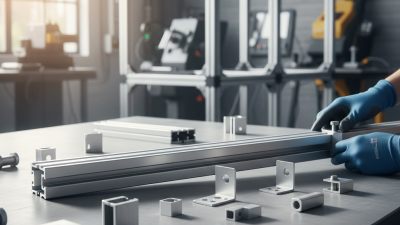
An aluminium T-slot profile is an extruded bar with one or more T-shaped grooves running along its length. These slots accept sliding nuts, bolts, and connector plates, allowing frame parts to be joined without welding. Cut the profile to length, position a nut in the groove, and tighten a bracket against it. The connection can later be loosened and moved. This makes T-slot profiles useful for machine guards, workbenches, equipment stands, and adjustable enclosures. The shape and wall thickness vary, so load capacity depends on the profile and the joint design—not just the material.

Aluminium has a density of about 2.70 g/cm³, according to the International Aluminium Institute, making it considerably lighter than steel. That can make frames easier to handle, though lightness alone does not guarantee stiffness. Check span, load, and deflection before choosing a section. The Institute also reports that recycled aluminium requires about 5% of the energy used to produce primary aluminium. This is useful context, but actual environmental performance depends on the material source and manufacturing process. In practice, getting a square, rigid frame still takes patience; adjustable parts can shift while being tightened.

Tips: Keep nuts and connectors compatible with the slot dimensions. Tighten joints gradually, checking squareness with a small engineer’s square. For long spans or moving loads, test a sample assembly before building the full frame.

Why Use Aluminium T Slot Profile for Modular Frames? - What Is an Aluminium T-Slot Profile?

Dimension What It Means Typical Characteristics Why It Matters for Modular Frames
Profile design An extruded aluminium section with longitudinal T-shaped slots. Slots accept compatible T-nuts, bolts, brackets, and other fastening hardware. Components can be positioned and attached along the profile without drilling new mounting holes for every adjustment.
Common profile sizes Profiles are commonly described by their outside dimensions, such as 20 × 20 mm, 30 × 30 mm, 40 × 40 mm, or 40 × 80 mm. Actual dimensions, slot geometry, and compatible hardware vary by profile system and manufacturer. A broad range of section sizes supports different frame layouts, from light-duty enclosures to larger equipment frames.
Slot and fastener compatibility Slot openings and internal dimensions determine which T-nuts and fasteners fit. Some systems use nominal slot widths around 6, 8, or 10 mm; these are not universally interchangeable. Matching the hardware to the exact profile system helps ensure proper fit and secure connections.
Material and finish Profiles are made from aluminium alloy; many are supplied with a protective anodized surface. Alloy, temper, wall thickness, and finish depend on the specific product specification. Aluminium offers a relatively lightweight structural material, while an anodized finish can help protect the surface during normal use.
Assembly and modification Frames are assembled with compatible connectors and fasteners rather than relying solely on permanent welded joints. Members and accessories can generally be repositioned by loosening and retightening the fasteners. This makes layout changes, repairs, and reuse of components more practical.
Accessories Common additions include corner brackets, joining plates, hinges, handles, leveling feet, and panels. Accessory fit depends on profile dimensions, slot geometry, and the chosen connection method. A compatible accessory range can simplify the construction of guards, workstations, machine frames, and enclosures.
Load capacity Capacity depends on the profile section, span, support arrangement, connection hardware, and direction of loading. There is no single load rating that applies to all T-slot profiles or frame assemblies. Use engineering data for the exact components and check deflection and joint strength for the intended application.
Best-fit applications Modular structures that may need adjustment, expansion, or component replacement. Examples include equipment supports, test rigs, machine guards, display frames, and workstations. The slot-based system enables flexible assembly, but the profile and joints must still be selected for the required loads and operating conditions.

How Do T-Slot Profiles Form Modular Frames?

How Do T-Slot Profiles Form Modular Frames?

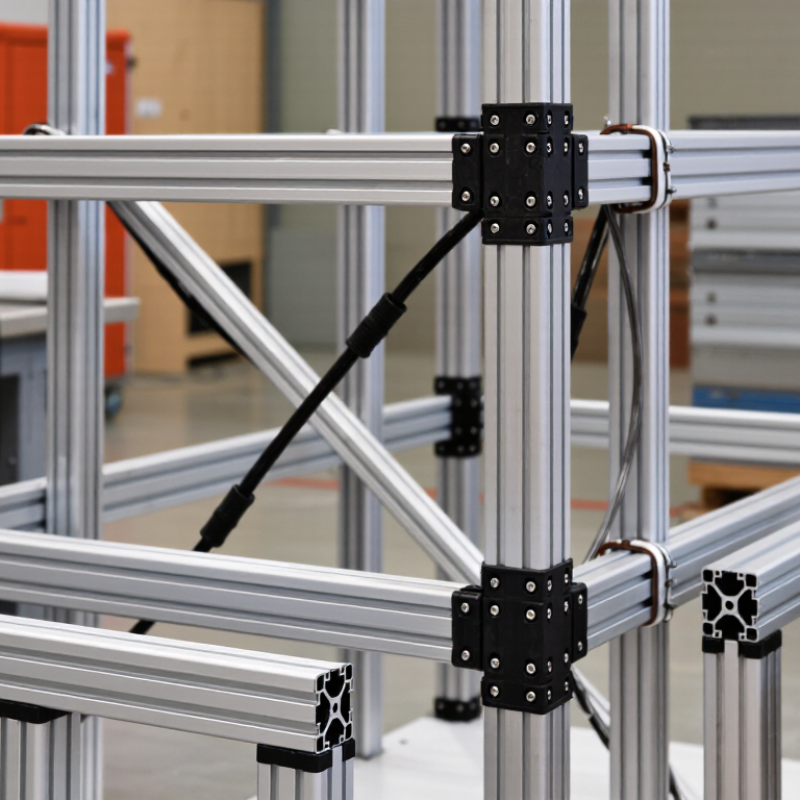
T-slot profiles form modular frames through slotted aluminum beams, connectors, and fasteners. The T-shaped grooves run along each beam, allowing sliding nuts to sit inside the channels. Corner brackets or internal connectors then join the beams at chosen angles. A simple workbench frame might use four vertical posts, horizontal rails, and adjustable feet. No welding is needed, and parts can often be repositioned with basic hand tools.

Accurate cuts and square joints matter. Even a small alignment error can make doors bind or panels sit unevenly. Builders usually assemble the frame loosely, check its diagonals, and tighten bolts after confirming the corners are square. This is practical, though not foolproof; long beams can flex during assembly, and heavy loads may require cross-bracing. The slot layout also affects where panels, hinges, and accessories can attach. Plan their positions before tightening every connection.

Tips: Keep a small square and level nearby. Use compatible slot nuts, and avoid overtightening. Check the frame under its expected load; a design that looks rigid may still sway.

Why Use Aluminium T-Slot Profiles for Modular Frames?

Lower material density can make a frame easier to handle and reposition. T-slot profiles also allow components to be attached and rearranged using compatible fasteners, without welding.

Typical material densities: aluminium alloys, about 2.70 g/cm³; carbon steel, about 7.85 g/cm³; stainless steel, about 8.00 g/cm³. Values are representative and vary by alloy and grade. Density alone does not determine frame strength or suitability.

What Benefits Do They Offer Over Other Frame Materials?

Aluminium T-slot profiles are useful when a frame may need to change after installation. Their grooves accept sliding nuts and standard joining plates, so a technician can reposition a sensor bracket without drilling new holes. That saves time during prototype adjustments and line-side repairs. Small changes matter.

Compared with welded steel, aluminium profiles are lighter and usually easier to carry, cut, and assemble with basic workshop tools. They do not need paint to cover rust in ordinary indoor conditions, though surface damage and harsh environments still deserve attention.

Compared with timber, they offer more consistent dimensions and do not warp with everyday moisture changes. Timber can still be cheaper or better suited to a one-off fixture.

The trade-off is rigidity. A long aluminium span may flex more than a similarly sized steel member, especially under vibration or a heavy load. Profile size, connector quality, and bracing all affect performance. For example, a guard frame holding a small control panel may need little reinforcement, while a machine support could require larger sections and cross-braces. Check the supplier’s load data and test the assembled frame under realistic conditions; modular convenience does not replace sound engineering.

Where Are Aluminium T-Slot Frames Commonly Used?

Aluminium T-slot frames are common in factory automation, where equipment layouts change as production needs shift. They support machine guards, sensor mounts, workstations, and light-duty conveyor structures. A technician can move a bracket along the slot without drilling a new hole. That small adjustment can save time during a line change.

They also appear in laboratories and testing areas. Engineers use the profiles to build instrument stands, optical benches, and adjustable enclosures. A square frame can hold a camera above a sample, while sliding mounts help align lights and sensors. For clean assembly spaces, smooth surfaces are easier to wipe than many exposed steel structures, though dirt can still collect inside open slots.

In workshops, training rooms, and prototype areas, T-slot frames make useful benches, carts, and equipment racks. The parts are reusable, which suits projects that evolve. Not every frame is equally rigid. Long spans, heavy loads, and vibration may require larger profiles, extra braces, or a different structure. A quick mock-up can reveal a weak corner before equipment is installed. That is easy to overlook.

What Factors Guide Profile Selection and Assembly?

Selecting an aluminium T slot profile starts with the load, span, and expected deflection—not the outside dimensions alone. A 40 mm profile may look substantial, yet a long unsupported beam can still flex under a moving load. Check the supplier’s second moment of area and load tables, then compare them with your actual span and connection layout. For repeated impacts or cantilevered equipment, allow extra margin. A static bench test is useful, but it may not reveal vibration problems.

Slot size and assembly method matter just as much. Match fasteners, brackets, and panel thickness to the profile’s slot geometry; small mismatches can leave joints loose or panels rattling. Think about access, too. Can a wrench reach the inside corner after the frame is built? Design around standard cuts where possible, but verify tolerances before ordering many pieces. Mistakes get expensive.

Material use and durability deserve a closer look. The International Aluminium Institute’s 2021 Global Aluminium Cycle report estimates that about 75% of all aluminium ever produced remains in use. That supports aluminium’s circularity, though it does not guarantee that a particular frame will be recycled. Specify alloy and temper based on load and operating conditions, and consider corrosion exposure near wash-down areas. A little imperfect fit can be corrected; a poorly sized beam is harder to forgive.